

Asus TUF Gaming RTX 3080 OC Review
Today nosotros're reviewing the Asus TUF Gaming RTX 3080 OC, the outset third-party GeForce RTX 3080 graphics card to come our manner and we're very interested to see how it compares to Nvidia'due south Founders Edition model. We'll exist checking out gaming performance which should be very similar to the FE card, simply besides thermal and overclocking results.
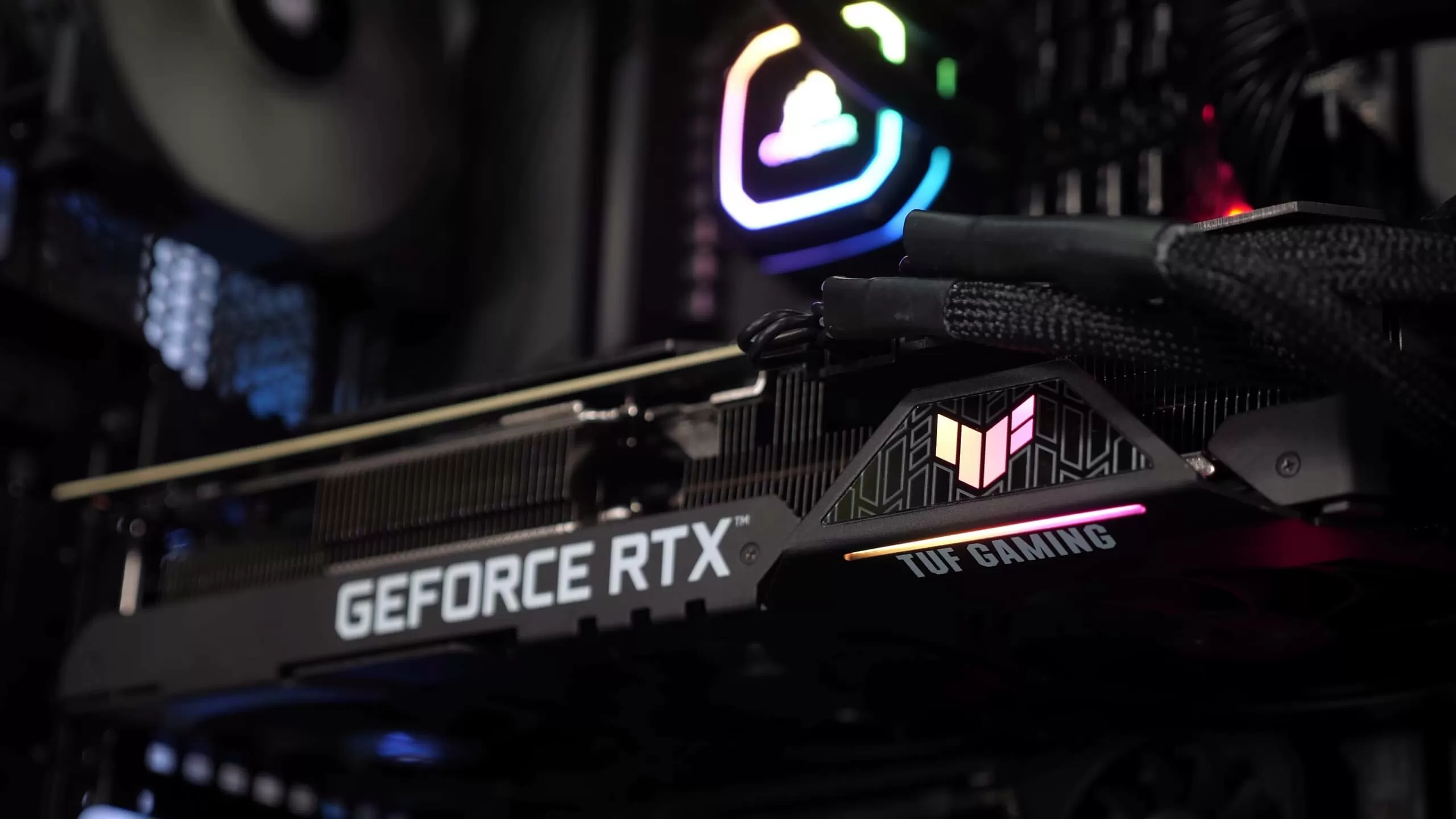
First, permit'southward tear the TUF Gaming RTX 3080 OC down and take a await at the libation and PCB. Please note this was washed after we collected all our thermal and performance data. Starting with LED lighting, because of course, that'southward of import. The TUF is minimalist which we like, there is a pocket-size light bar above the 'TUF' branding forth with a backlit logo which faces outwards when the card is traditionally mounted.
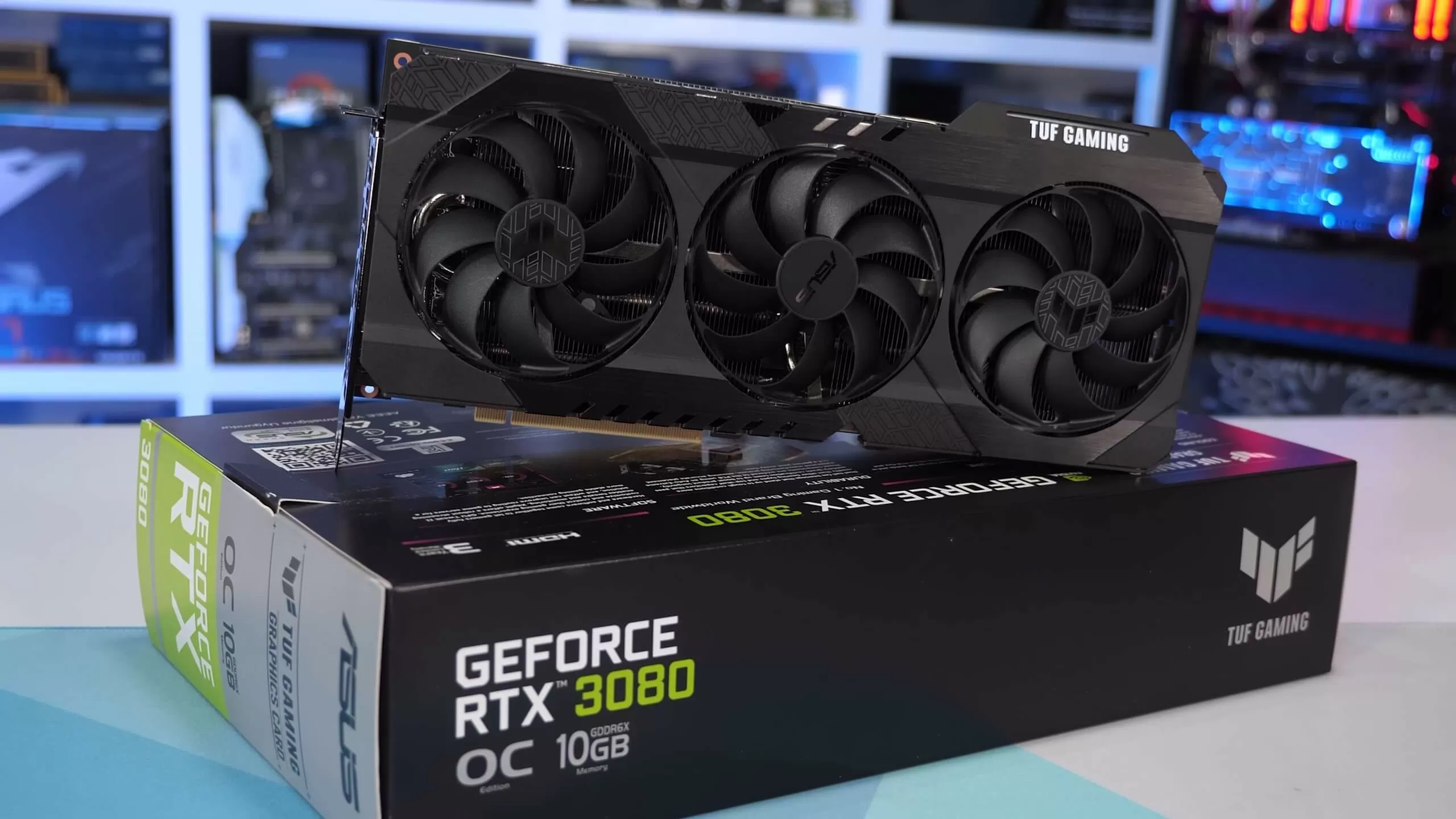
In terms of design and appearance, the TUF Gaming looks like your typical loftier-stop graphics card. It's a ii.7-slot design, so it takes up three slots, it measures 30cm long, stands 12.7cm tall and weighs in at 1385 grams, so it'south slightly heavier than the 1355 gram Founders Edition model. It's more often than not black, so information technology volition suit most builds and Asus has included a few 'TUF' theme design elements similar the tire tracks on the backplate, for case.
We liked how in that location's no plastic on the card, apart from the fans of course. The fan shroud has been synthetic from aluminum, giving it a premium await. Asus are also using the centric-tech fans and since there are three in total, they've reversed the rotation of the centre fan to reduce turbulence, the fans each measure 90mm in diameter. We should also note that the card includes a cease-fan characteristic which activates when the GPU drops below 55C.

Around at the I/O end of the card we detect ii HDMI two.one ports and 3 DisplayPort 1.4a outputs. That's an extra HDMI output when compared to Nvidia'due south FE version, though annotation information technology can still but support up to 4 simultaneous displays. Asus also points out that this model features a very robust stainless steel I/O bracket which they say protects against rust while providing a more durable and secure mount. Can't say we've e'er had an upshot with the standard steel brackets, merely if you have, well this volition be a welcomed feature.

Pulling this affair autonomously to take a better wait, starting with the heatsink and fans, nosotros have a very serious looking heatsink here, in fact it looks similar something y'all'd await to notice on an ROG Strix model and not a carte with TUF branding, and information technology really is very large, weighing in at 820 grams.
There are ii massive banks of fins which are connected using one-half a dozen 6mm thick nickel plated copper heatpipes, and all connect to a large nickel plated copper base of operations plate.

Using an aluminum plate, information technology straight cools the VRM, so that'southward good to come across, but there'south a lot more to this design as there is a second heatsink which directly cools the GDDR6X retentivity likewise every bit the ability delivery for the retention components. It's an impressive bit of kit that fits in snug beneath the principal heatsink. Asus have besides used a few loftier quality thermal pads to aid in rut transfer from this smaller heatsink to the primary heatsink. Oh and for those of yous wondering the smaller heatsink weighs in at 70 grams.


On the back side of the card we find a rather thick aluminum dorsum plate which weighs 138 grams and has been used to strengthen the card and reduce PCB sag, or in this instance completely eliminate information technology. We call up this is actually the thickest backplate we've ever seen on a graphics card. Asus has too employed a series of thermal pads to remove built upwardly estrus from the rear side of the PCB behind the VRM and GDDR6X memory chips. In that location's also a few cut outs to aid in air-flow.
Now over to the PCB, we find a 24cm long by 10.6cm tall PCB, so a adequately compact board, though information technology is crammed full of components. Surrounding the massive GA102 die are the GDDR6X memory chips then flanking them on either side are boatloads of inductors and ability stages. In total the carte du jour packs 20 power stages, and here we're looking at an 8 + 6 + 4 power stage pattern using SIC641ACD 55A powerstages, though delight note two of the eight-phases drive two power stages, then a bit of an odd configuration, but this is what Asus has gone with.


If yous're wondering what the eight and 6-phase portions power, the answer is the GPU. And so xiv phases feed into the GPU, or 16 55A powerstages. The 8-stage power runway is for NVVDD and the 6-stage power rail is for MSVDD while the 4-phase ability runway is for the GDDR6X retention.
For comparing, the Nvidia reference lath uses an 8 + 5 + 3 power phase design featuring 50A Alpha & Omega Semiconductor power stages. In other words, Asus has beefed up the TUF Gaming well over the Nvidia reference spec.

There's as well two viii-pin PCIe power connectors feeding power into the graphics card and you'll also find a dual BIOS switch that allows yous to change from the default 'operation' BIOS to a 'quiet' BIOS. Both modes run the card at 340 watts, so we're just looking at a change to the fan profile which will see the bill of fare run hotter in the repose mode.
In terms of clock specifications, Asus lists a core clock frequency of 1815 MHz which is a 5% boost over the 1730 MHz default spec. The GDDR6X memory though has been left at 19 Gbps, so we're just looking at a typical mild GPU overclock here. All that said, let'southward move on to see what clock speed this model maintains when underload.
For these GeForce 30 series graphics bill of fare reviews we'll be using Shadow of the Tomb Raider for all stress testing and will be reporting temperatures after xxx minutes of gameplay. This saw the TUF Gaming peak at just 63 degrees in a 21 degree room inside the Corsair Obsidian 500D, fully populated with fans. That's a massive 15 degree drop in temperature when compared to Nvidia'south Founders Edition model.


To maintain this temperature the fans spin at up to 1900 RPM and while that'due south a reasonably high fan speed, the card was surprisingly quiet, generating only 42 dBA of noise, making it slightly quieter than the FE version. The typical core clock speed seen during our testing was 1935 MHz and nether the aforementioned conditions that'due south a 5% increase over the Founders Edition model. This saw power consumption increase by 7% from 323 watts with the FE model to 344 watts with the TUF Gaming.
Overclocking
Now for overclocking, with the limits reached we once more saw a top operating temperature of 63 degrees but this fourth dimension the fans spun up to 2000 RPM. The card wasn't terribly loud at this fan speed. The overclock saw the cores operate at 2 GHz and the retention also hitting 20.6 Gbps, an impressive transfer speed. Finally, when overclocked the card sucked down 357 watts, a minor four% increase from the manufactory OC configuration.
Permit'south movement into the benchmark graphs to run across what overclocking gets us. We're testing with our Ryzen 9 3950X GPU test rig with 32GB of DDR4-3200 CL14 memory. The latest drivers available at the time of testing have been used, and for this i we have merely a few select games to look at.
Benchmarks
Starting with Death Stranding numbers at 1440p, the TUF Gaming was a single frame faster than Nvidia'due south Fe model, striking 158 fps. That'due south a pretty disappointing increase and we weren't able to practise much improve with a manual overclock, boosting functioning by a further 2%.

The results at 4K were just as underwhelming, hither the TUF Gaming was 2% faster than the FE model and our overclock netted usa an extra 2% operation.

The gains seen in Rainbow Six Siege were a little more than impressive, here the TUF Gaming was six% faster than Nvidia'southward FE model, hitting 346 fps. That'southward a typical factory overclock, just unfortunately through further transmission tuning we were only able to excerpt 2 extra frames, well nether a unmarried percent gained here.


The 4K data looks much the same, once again the TUF Gaming was 6% faster than Nvidia'southward Founders Edition model and our manual overclock was useless.
Shadow of the Tomb Raider saw a four% increase for the TUF Gaming over the Atomic number 26 model at 1440p, though quite interestingly this time our transmission overclock netted us a further 3% increase in performance.


Similar margins were seen at 4K, here the TUF Gaming was 5% faster out of the box and then 8% faster with our overclock, though that was only a 3% increase over the Asus manufacturing plant overclock.
Temperatures
Here's a more in-depth look at the stock temperatures after running Shadow of the Tomb Raider for 30 minutes in a 21C room. The PCB temperatures were recorded using K-type thermocouples. For the GPU rear PCB temp the probe is attached to the backside of the PCB behind the GPU and nosotros were expecting temperatures to be higher, so it would seem the heatsink on the frontside does a good job of extracting rut from the GPU. The GPU die temperature is the event y'all've already seen, we're just reporting the internal sensor hither.

Then the GDDR6X temperature has been reported using a thermal probe, fastened to the PCB between the retentivity chips, and then that it doesn't interfere with the thermal pad and it'southward contact with the memory chip. The same method was used to measure VRM temperatures, iv probes were used to find the VRM hot spot and here we're looking at a peak of 66C which is very adept. Overall, the TUF Gaming runs surprisingly absurd.
What's to Like
Asus has done an fantabulous task with the TUF Gaming RTX 3080 OC, it's a great quality graphics card and better than Nvidia's own Founders Edition in every measurable mode. It's quieter, significantly cooler, faster out of the box and best of all, it doesn't require a silly 12-pivot ability adapter or specialized cable.
The only area where the Founders Edition model might be amend is the concrete advent, but that's entirely subjective. While nosotros do similar the expect of Nvidia's version, the TUF Gaming still looks great and nosotros appreciate the utilise of high quality materials all around.

The fact that the TUF Gaming can be upward to 6% faster while running 15C cooler seals the deal for u.s.a.. There's merely no way we'd purchase the Founders Edition over this Asus model for the same price.
At this indicate we're still in the procedure of checking out other AIB RTX 3080 cards, so in that location might be better options, but nosotros tin't imagine they're going to be that much improve. Nosotros've seen numerous 5700 XT graphics cards that run hotter than the TUF Gaming RTX 3080 OC, and so at that place's no denying Asus has done an excellent job. Should the price exist right, and then we see no reason not to buy this graphics card.

The Asus TUF Gaming RTX 3080 OC is currently listed for $700, which matches the MSRP for standard RTX 3080 boards. That said, it's too out of stock everywhere we looked, but if you can eventually snag one for $700, then y'all've washed very well.
We were surprised to find how much improve this thing is than Nvidia'southward intricate Founders Edition, and we like to retrieve that our scrutiny with previous TUF Gaming cards helped motivate Asus to put together this splendid design and attention to detail.
Shopping Shortcuts:
- Nvidia GeForce RTX 3080 on Amazon
- AMD Radeon RX 5700 on Amazon
- AMD Ryzen 9 3900X on Amazon
- AMD Ryzen 5 3600 on Amazon

Source: https://www.techspot.com/review/2102-asus-tuf-geforce-rtx-3080/
Posted by: westmanannert.blogspot.com
0 Response to "Asus TUF Gaming RTX 3080 OC Review"
Post a Comment